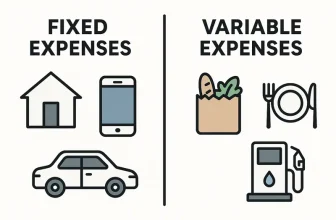
The 50/30/20 rule is a proportional budgeting framework designed to organize personal cash flow into three distinct categories: essential needs, discretionary wants, and financial goals. This method provides a mathematical baseline for individuals to manage their monthly after-tax income, ensuring that fixed obligations are met while systematically allocating funds toward savings and debt reduction.
In the context of wealth education, this rule addresses the primary challenge of capital identification—determining exactly how much capital is available to be deployed into various financial vehicles. By establishing a ceiling on consumption and a floor for savings, it functions as a structural component of the broader process of learning how to start investing with little money.
What You Need to Know First
Before implementing the 50/30/20 rule, it is necessary to understand the specific definitions and preconditions that govern its effectiveness. This framework is built upon “after-tax income,” also known as take-home pay or net income.
Key Definitions
- After-Tax Income: For salaried employees, this is the amount remaining on a paycheck after federal, state, and local income taxes, Social Security, and Medicare (FICA) have been deducted. It does not typically include voluntary deductions like 401(k) contributions or health insurance premiums, though these must be accounted for in the final calculation to ensure accuracy.
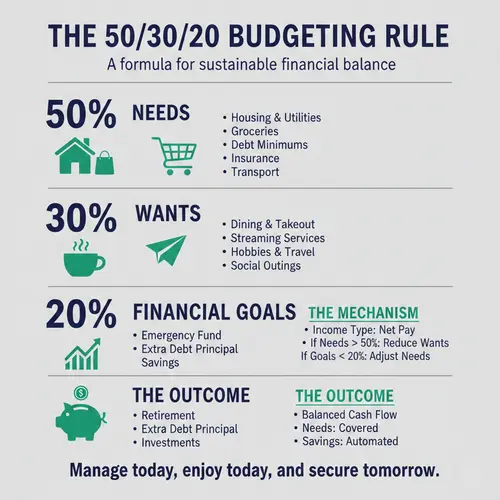
- Needs (50%): These are non-negotiable expenses required for basic survival and the maintenance of one’s livelihood. This includes housing, utilities, basic groceries, transportation, insurance, and minimum required debt payments.
- Wants (30%): Discretionary expenses that enhance lifestyle but are not essential for survival. This includes dining out, travel, hobby-related costs, and premium subscription services.
- Savings and Debt Repayment (20%): This category is dedicated to the “future self.” It encompasses emergency fund contributions, retirement account deposits, brokerage account investments, and any debt payments made above the required minimum.
Preconditions and Requirements
To use the 50/30/20 rule successfully, an individual must have access to at least three months of historical spending data. This data is required to distinguish between recurring fixed costs and variable discretionary spending accurately. Furthermore, the rule assumes a standard economic environment; in cases of extreme debt-to-income ratios or living in hyper-expensive urban centers, the 50% threshold for needs may require temporary adjustment.
Constraints and Tradeoffs
The primary constraint of this rule is its rigidity regarding proportional allocation. For high-income earners, a 30% allocation to “wants” may represent excessive consumption, while for low-income earners, 50% may be insufficient to cover housing in certain jurisdictions. The tradeoff of this system is simplicity for precision. While more complex budgeting systems (such as zero-based budgeting) account for every cent, the 50/30/20 rule focuses on high-level percentages to maintain long-term sustainability.
Step-by-Step Process
Implementing the 50/30/20 rule requires a systematic approach to data collection and categorization.
1. Calculate Monthly After-Tax Income
What to do: Review pay stubs or bank deposit statements to determine the total amount of money entering your accounts each month. If you have automated deductions for retirement (401k) or health insurance, add those back into your “net” total to see your true after-tax starting point, as these are technically part of your 20% savings or 50% needs, respectively. Why it matters: Basing a budget on gross income (before taxes) leads to overestimating available cash, which can result in deficit spending. Common errors: Failing to include “side hustle” income or irregular bonuses, which can skew the percentages.
2. Categorize the Last 30 to 90 Days of Spending
What to do: Audit bank and credit card statements. Label every transaction as a Need, a Want, or a Saving/Debt payment. Why it matters: Most individuals underestimate their discretionary spending. A factual audit provides the baseline necessary for adjustment. Common errors: Misclassifying “wants” as “needs.” For example, while a phone plan is a “need,” a top-tier unlimited data plan for entertainment may contain a “want” component.
3. Cap “Needs” at 50% of After-Tax Income
What to do: Total your essential costs. If they exceed 50% of your net income, you must identify areas for reduction (e.g., downsizing housing, switching insurance providers, or reducing utility consumption). Why it matters: When needs exceed 50%, they begin to “crowd out” the ability to save or invest, creating long-term financial fragility. Common errors: Including minimum credit card payments in “Savings” because they are debt-related. Minimum payments are “Needs” because they are required to prevent default.
4. Limit “Wants” to 30% of After-Tax Income
What to do: Sum your discretionary spending. If it exceeds 30%, identify specific lifestyle choices to eliminate until the total falls within the threshold. Why it matters: This category is the most flexible and provides the fastest route to rebalancing a budget. Common errors: Assuming that “Wants” should always be 30%. If your needs are lower than 50%, the surplus should ideally move to the 20% category rather than increasing “Wants.”
5. Allocate 20% to Savings and Debt Repayment
What to do: Direct the remaining 20% of your income toward an emergency fund, high-interest debt overpayments (like credit cards), and long-term investment accounts. Why it matters: This is the wealth-building engine of the budget. Consistent 20% allocation ensures that capital is available for compounding growth. Common errors: Treating this category as “whatever is left over” at the end of the month. To be effective, this 20% should be moved to savings or investment accounts immediately after receiving income.
Key Decisions and Variations
While the 50/30/20 rule provides a standard benchmark, users must often make specific decisions based on their financial landscape. Try the 50/30/20 Budget Calculator to apply this budget rule to your finances.
The “Grey Area” Expenses
One of the major decision points involves expenses that sit between categories. For example, a basic internet connection is often a “need” for employment, but high-speed gaming internet is a “want.” In these cases, the standard practice is to categorize the base cost as a need and the premium as a want.
Adjustments for High-Cost Areas
In cities where rent consumes a disproportionate amount of income, the 50/30/20 rule may be modified to a 60/20/20 or 70/20/10 structure. However, this is generally considered a temporary measure. The objective remains to return to the 50/30/20 baseline by either increasing income or reducing fixed costs.
Debt Prioritization
When applying the 20% category, a key decision is whether to prioritize debt repayment or savings. Generally accepted financial principles suggest building a small emergency fund (1-3 months of expenses) first, then aggressively paying down debt with interest rates above 7-8%, before moving into long-term market investments.
Common Mistakes and Misconceptions
Understanding the limitations of the 50/30/20 rule prevents the frustration that often leads to budget abandonment.
- Mistake: Using Gross Income instead of Net Income. Taxes are not part of the 50/30/20 calculation; they are an external constraint. Budgeting based on gross income will invariably lead to a shortfall.
- Misconception: The 30% “Wants” is an entitlement. The rule does not mandate that 30% must be spent on luxuries. It is a maximum limit.
- Mistake: Ignoring Occasional Expenses. Many users forget to account for annual insurance premiums, car registrations, or holiday spending. These should be averaged into monthly “Needs” or “Wants” to avoid breaking the budget during those specific months.
- Misconception: Savings is only for the bank. In this framework, “Savings” includes any contribution toward net worth, including the principal portion of a mortgage payment or contributions to a 401(k).
How This Connects
The 50/30/20 rule is a practical mechanism for capital generation. For those exploring how to start investing with little money, the primary obstacle is often a perceived lack of surplus funds. By strictly limiting discretionary spending to 30% and capping needs at 50%, the rule “uncovers” the 20% that can be redirected into the market.
For a detailed look at where to place these identified funds, you should refer to the How to Start Investing with Little Money: A Beginner’s Guide. Mastering the allocation of your current income is the prerequisite step to becoming an active participant in the investment landscape.
Summary
The 50/30/20 rule is a foundational financial logic that ensures balance between current obligations, current lifestyle, and future security. Its effectiveness depends on the accurate categorization of expenses and the disciplined adherence to its percentage-based caps. By maintaining a 50% limit on needs and a 30% limit on wants, individuals ensure that 20% of their after-tax income is consistently available for debt reduction and wealth accumulation.