Accelerated equity refers to the proactive implementation of financial and operational strategies designed to increase the difference between a property’s market value and its outstanding mortgage balance at a rate that exceeds the standard amortization schedule. This process addresses the financial objective of maximizing net worth and reducing debt liability faster than the timeline dictated by a traditional 30-year loan agreement. Within the broader context of strategies to build home equity, these methods serve as the active mechanisms used to alter the inputs—specifically the loan balance and property value—that are measured when determining a homeowner’s financial stake in a property.
What You Need to Know First
Before attempting to accelerate home equity, it is necessary to understand the fundamental mechanics of mortgage amortization and asset liquidity.
Key Definitions
- Amortization: The schedule by which a loan is paid off over time. In the early years of a standard mortgage, the majority of a monthly payment is applied to interest, with a smaller portion reducing the principal balance.
- Principal: The amount of money originally borrowed that has not yet been repaid. Reducing the principal is the direct mechanism for increasing equity on the debt side of the equation.
- Forced Appreciation: An increase in property value resulting from physical improvements or renovations, as opposed to passive appreciation driven by market forces.
- Loan-to-Value (LTV) Ratio: A financial metric comparing the amount of the loan to the appraised value of the asset. When you accelerate home equity, you directly lower the LTV ratio.
Constraints and Risks
The Liquidity Trap: Home equity is an illiquid asset. Capital used to pay down a mortgage principal is no longer accessible for emergencies or other investments unless the homeowner sells the property or obtains a new loan (such as a HELOC).
Prepayment Penalties: Some mortgage contracts include provisions that charge a fee if the loan is paid off or significantly reduced within a specific timeframe (typically the first 3 to 5 years).
Opportunity Cost: Funds allocated to accelerate home equity (yielding a return equal to the mortgage interest rate) cannot be invested in other vehicles that might offer higher historical returns.
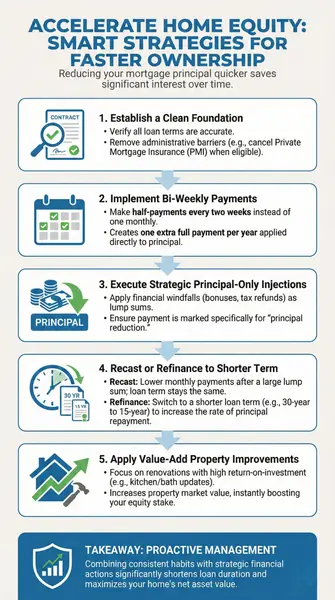
Step-by-Step Process for Accelerating Equity
The following steps outline the specific methodologies for accelerating equity accumulation. These steps focus on manipulating the two variables of equity: decreasing debt and increasing value.
1. Verify Loan Terms and Remove Administrative Barriers
What to do: Review the Closing Disclosure or current mortgage statement to confirm the absence of prepayment penalties. Contact the loan servicer to determine their specific procedure for processing “principal-only” payments. Some lenders require specific notation on checks or selection of a specific option in online portals; otherwise, they may apply extra funds to future interest or hold them in a suspense account.
Why it matters: If extra payments are not correctly applied to the principal balance immediately, they do not reduce the interest calculation for the subsequent month, nullifying the acceleration effect.
Common errors or misapplications: Assuming that simply sending a larger check automatically reduces the principal. Lenders often default to applying the excess to the next month’s standard payment (pre-paying the interest), which offers no interest savings or equity acceleration.
2. Implement a Bi-Weekly Payment Structure
What to do: Divide the standard monthly mortgage payment by two and make that payment every two weeks. This results in 26 half-payments per year, which is mathematically equivalent to 13 full monthly payments.
Why it matters: This is a proven method for how to pay off mortgage faster without a significant monthly cash-flow shock. On a typical 30-year fixed-rate mortgage, this single extra annual payment can reduce the loan term by approximately 4 to 6 years, depending on the interest rate, significantly accelerating the principal pay-down curve.
Common errors or misapplications: Paying a third-party service provider to set up bi-weekly payments. These services often charge enrollment and transaction fees that erode the savings. Homeowners should execute this manually or through their lender’s direct system if available fee-free.
3. Execute Strategic Principal-Only Injections
What to do: Allocate lump sums from bonuses, tax refunds, or windfall gains directly toward the mortgage principal. Alternatively, add a fixed dollar amount (e.g., $100 or $500) to every scheduled monthly payment, specifically designated for principal reduction.
Why it matters: Because mortgage interest is calculated on the outstanding balance, every dollar that reduces the principal permanently lowers the interest charged in every subsequent month for the life of the loan. This creates a compounding effect where more of each future standard payment is applied to principal rather than interest, helping to accelerate home equity with every payment.
Common errors or misapplications: Inconsistent application. While lump sums are effective, they rely on variable income events. Small, consistent additions to the monthly payment generally yield more predictable amortization shortening.
4. Recast or Refinance to a Shorter Term
What to do: If interest rates are favorable, refinance a 30-year mortgage into a 15-year or 10-year mortgage. Alternatively, if a large lump sum has been paid, request a “mortgage recast” from the lender to re-amortize the remaining balance over the existing term (though this lowers payments, maintaining the original payment amount after a recast accelerates equity).
Why it matters: A 15-year mortgage has a steeper amortization curve. Mandatory principal payments are significantly higher each month compared to a 30-year loan, forcing equity accumulation at roughly double the speed.
Common errors or misapplications: Ignoring closing costs. Refinancing costs money (appraisals, origination fees). If the homeowner intends to move within the break-even period (the time it takes for interest savings to exceed closing costs), this strategy results in a net loss.
5. Apply Value-Add Property Improvements
What to do: Invest in physical renovations that increase the fair market value of the property. Focus on projects with high cost-recovery ratios, such as minor kitchen remodels, siding replacement, or adding square footage (e.g., finishing a basement or attic) where permitted by zoning.
Why it matters: Equity is defined as Market Value minus Mortgage Balance. Increasing the market value increases equity even if the mortgage balance remains static. This is the core principle behind forced appreciation real estate investments.
Common errors or misapplications: Over-improving for the neighborhood. If a property is improved to a value significantly higher than comparable homes in the area, the market value may not reflect the full cost of renovations due to the “principle of regression” in real estate appraisal.
Key Decisions and Variations
Lump Sum vs. Periodic Increments
The decision between making one large principal payment annually versus small monthly additions often depends on income structure.
- Periodic Increments: Best for salaried employees with fixed budgets. It instills discipline and integrates equity building into monthly fixed costs.
- Lump Sums: Appropriate for commissioned workers or those with performance bonuses. This variation requires discipline to not divert the funds to discretionary spending.
Investing vs. Prepaying Mortgage
This is a mathematical comparison of rates of return.
- The Decision: A homeowner must decide whether to allocate surplus cash to the mortgage (guaranteed return equivalent to the mortgage interest rate) or to investment vehicles (variable return).
- Variance: In a high-interest-rate environment (e.g., mortgage rates above 6-7%), the decision to accelerate home equity yields a guaranteed, risk-free return that is competitive with equities. In a low-interest-rate environment (e.g., mortgage rates below 3-4%), the opportunity cost of prepaying is higher, as market investments often outperform the interest savings.
Passive vs. Active Appreciation Strategies
- Passive: Relying on general market inflation and neighborhood demand. This requires no capital outlay but offers no control over the timeline.
- Active: Renovations require capital outlay and management but provide control over the value increase. The decision rests on the availability of cash reserves and the current condition of the property relative to the local market standard.
Common Mistakes and Misconceptions
Mistake 1: The “House Rich, Cash Poor” Imbalance
Misconception: That maximizing equity is always the safest financial position.
Fact: Aggressively paying down a mortgage reduces liquid cash reserves. If a homeowner faces an income loss or medical emergency, they cannot easily spend the equity in their home. They may be forced to sell or take on high-interest debt because they lack liquidity.
Mistake 2: Assuming Dollar-for-Dollar Return on Renovations
Misconception: That spending $50,000 on a renovation increases equity by $50,000.
Fact: Very few renovations return 100% of their cost in increased market value. According to cost vs. value data, most projects recoup between 50% and 80% of the expenditure. Therefore, renovations purely for equity acceleration (without utility to the occupant) often result in a net loss of total capital.
Mistake 3: Misunderstanding Interest Savings vs. Equity Build
Misconception: That tax deductions on mortgage interest justify keeping a mortgage.
Fact: Paying $1.00 in interest to save $0.24 in taxes (assuming a 24% marginal tax bracket) results in a net loss of $0.76. While the tax deduction mitigates the cost of borrowing, carrying debt solely for the tax benefit is mathematically inefficient compared to holding the equity.
Integration with the Home Equity Guide
The strategies detailed above provide the actionable steps required to alter the variables in the home equity equation. While the core guide explains the mathematical formula for determining your current standing, implementing these methods to accelerate home equity ensures that when you utilize the process described in the article on how to calculate home equity, the resulting figure reflects a stronger financial position. These strategies directly modify the “Current Market Value” and “Outstanding Loan Balance” inputs required for that calculation.
Summary
To accelerate home equity, homeowners must adopt a deliberate approach to either reducing debt liability or increasing asset value. By auditing loan terms for prepayment penalties, adopting a bi-weekly payment schedule, and making targeted principal reductions, homeowners can significantly shorten their amortization timelines. Simultaneously, strategic renovations can increase the property’s market value, widening the equity gap from the asset side. However, these actions must be balanced against liquidity needs and general market conditions. Correct execution relies on understanding the mathematics of compound interest and avoiding the error of over-capitalizing the property.